Cards numbered 1–90. Use every number exactly once across the three decks.

October research challenge / 2026
The Dealer’s
Second Game.
Ninety cards. Three decks. Two games. Can you reverse every advantage?
See results and solution ↓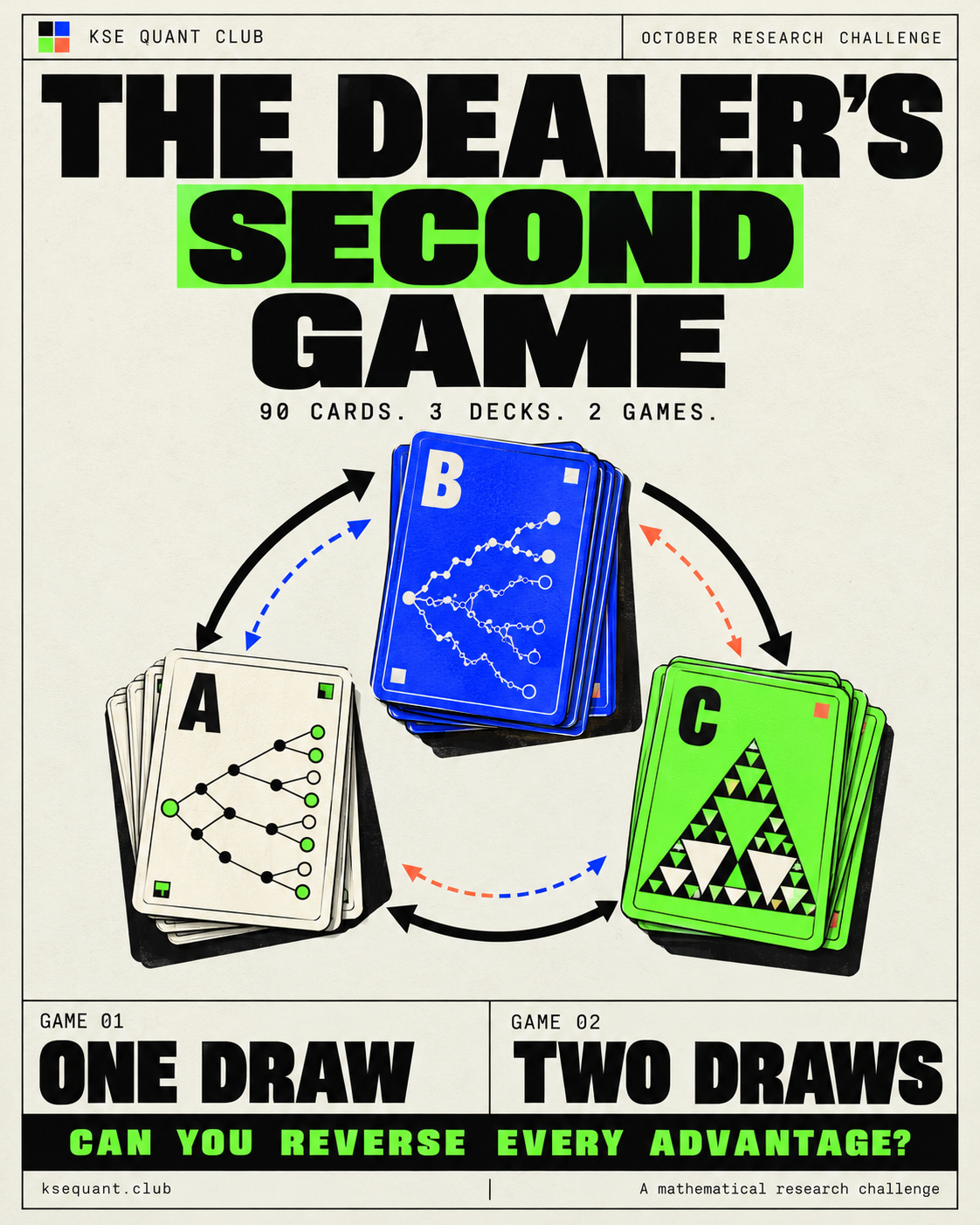
Deadline15 / 11 / 202623:59 Kyiv time · UTC+2
The prizeClub merchFor the winning submission
Your toolsThink. Test. Prove.Code & AI welcome — disclose their use
October Challenge / Results
All three matchups flipped.
Winning entry
Stanislav K.
52.6515%
Smallest of the six winning probabilities
Both competition entries reversed all three matchups. Their verified lower bounds were 52.6515% and 52.5772%. With the same certified universal upper bound of 2/3, the first entry had the smaller gap and wins the club merch.
The winning decks
- A1–7, 38–53, 84–90
- B8, 19–20, 22–37, 71, 73–82
- C9–18, 21, 54–70, 72, 83
Each deck contains 30 cards and sums to 1,365. Together they use the numbers 1 through 90 exactly once.
How to check the probabilities
With one draw, count the winning pairs out of 900. With two draws, list all 900 ordered sums in each deck, keeping repetitions. Compare the two lists: if W is the number of strict wins and T the number of ties, the probability is (2W + T) / 1,620,000. The factor of two accounts for the fair coin on ties.
| Draws | Matchup | Wins | Ties | Exact | ≈ % |
|---|---|---|---|---|---|
| 1 | A > B | 514 | 0 | 257/450 | 57.1111% |
| 1 | B > C | 514 | 0 | 257/450 | 57.1111% |
| 1 | C > A | 514 | 0 | 257/450 | 57.1111% |
| 2 | B > A | 424,276 | 4,402 | 142159/270000 | 52.6515% |
| 2 | C > B | 430,622 | 2,286 | 86353/162000 | 53.3043% |
| 2 | A > C | 424,544 | 4,420 | 213377/405000 | 52.6857% |
What we can prove about the optimum
Draw one card from each deck at the same time. In any triple, at most two of A > B, B > C and C > A can be true. So their probabilities sum to at most two, and at least one is at most 2/3. That also bounds the minimum over all six games and matchups.
142159/270000 ≤ p* ≤ 2/3
This is a verified construction, not a proof of global optimality. The submitted search checks a restricted family of deck arrangements; it has not been shown that this family contains a global optimum.
01 / The setup
Equal sums. Unequal chances.
The dealer lets you choose a deck first, then chooses another. You lose. You suggest drawing twice and comparing totals. The dealer smiles. Your task is to design the decks.
Cards in each deck: A, B and C.
The sum of the numbers in each deck must be the same: 1,365.
02 / Two games
One draw.
Draw one card uniformly at random from each chosen deck. The higher number wins.
A ≻ B · B ≻ C · C ≻ ATwo draws.
Draw twice from each chosen deck, replacing the first card before drawing again. Compare the sums. Settle equal sums with a fair coin.
B ≻ A · C ≻ B · A ≻ CAll draws are independent. X ≻ Y means that X wins with probability strictly greater than ½. The decks stay exactly the same in both games.
03 / The research question
How far can you push it?
Let p be the smallest of the six required winning probabilities. Let p* be the largest achievable p over all valid deck arrangements. Find a construction and a universal bound that trap the optimum:
L ≤ p* ≤ U
Build the lower bound L
Give an explicit valid arrangement, calculate all six probabilities as exact fractions, and take their minimum.
Prove the upper bound U
Prove that no valid arrangement can have all six probabilities greater than U. A complete, independently checkable computational certificate is also accepted; a heuristic search alone does not establish an upper bound.
04 / Archive
Submissions are closed.
The deadline was 15 November 2026 at 23:59 Kyiv time. Thank you to everyone who worked on the puzzle!
See the results and walkthrough ↑How we choose the winner
We check mathematical correctness first, then compare the smallest certified gap U − L. Ties are resolved by the larger achieved L, then clarity and reproducibility. Only justified bounds count. Finalists may be invited to explain their solution. The winning submission receives club merch; prize details will be coordinated with the winner.
Please keep solutions private until the deadline. Your contact details are used for this challenge and prize coordination. Questions or corrections: vportnaia@kse.org.ua.